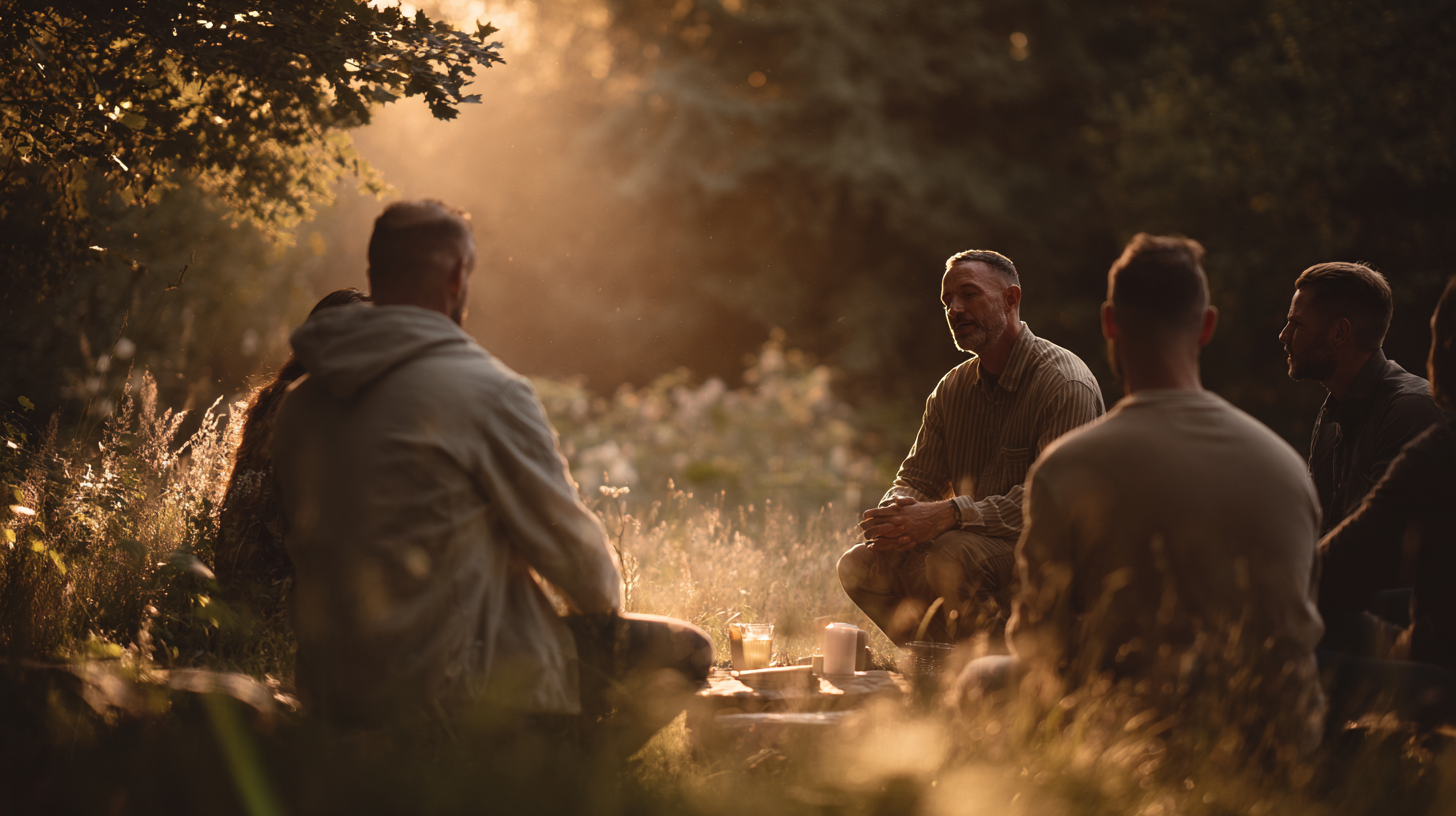
Do men’s circles involve religion or spiritual practices, or are they secular?
The simple answer is – usually no. Unless you join a circle in a church or the circle is led by a religious organisation, you should not expect to encounter any religious symbols during the circle, in how it’s run, or in what people are talking about. There may be some gentle spiritual practices, but they are always for a reason, and I would often argue that they should not be called “spiritual” in the first place.
For example, a circle might begin with a brief meditation or breathing exercise. It is not unusual for the circle to start from holding hands together to find connection and get on the same vibration as a group, since the whole reason why we are here is to connect. “Om chanting” is something that you can commonly experience, but I personally believe it is necessary to bring everybody together, to build the depth and prepare for deep, authentic sharing.
Who can join a men’s circle? Are they open to men of all ages, backgrounds, and orientations?
The simple answer is – usually yes. There are no limits or expectations, and everybody is welcome. From my experience, it’s rare to meet men younger than 20-25 years in circles, but that’s not a rule. Everybody is welcome, always. It’s an open space where bonds form, and variety actually brings many beautiful moments.
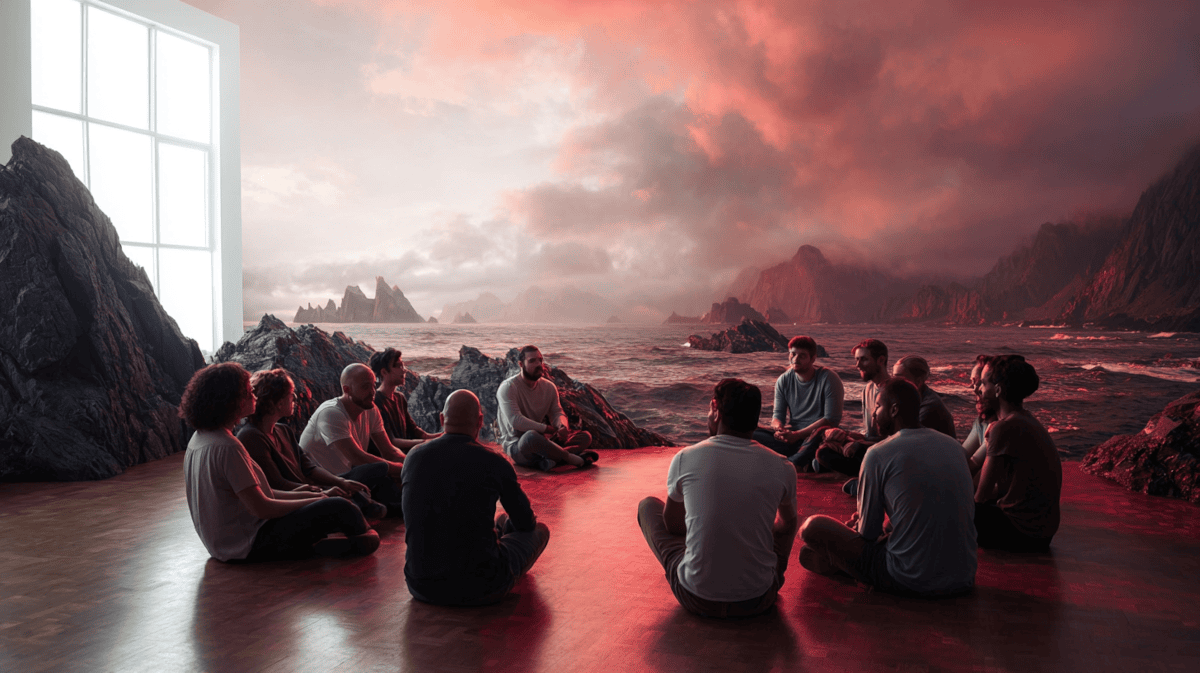
Are there different versions of men’s circles? How do they differ from each other?
All circles are focused on uninterrupted sharing, but typical, standard circles are only about that. Sharing, talking and letting go. There is no space for others to ask questions or provide feedback in any form. It is crucial in the process, as a lack of questions helps to open up a bit more.
Circles with questions are very similar to standard ones, but usually, there is a bit of time given at the end for others to ask questions. These questions are posed by other men and are designed to deepen the understanding of what has been said so far. There is no room for giving advice, but unfortunately, sometimes such advice is disguised as a question.
Active circles are again about sharing for a period of time, typically with more flexibility. Still, at the end, the facilitator (or more of them) can not only ask questions, but they might also do extra practices or exercises to help the sharing person connect with their feelings and release the emotions attached to them. As in the previous example, no advice is given.
Men's Circles
Join Men's Circles
Whether in person or online, Men’s Circles are a space to be real, heard, and supported without judgment. It’s where men gather to share stories, struggles, wins, and questions, and to remember that we don’t have to walk this road alone.

What topics can I talk about in a men’s circle? Are any subjects off-limits?
Any topic you wish is a good topic to discuss. The rule is very simple – the deeper we go, the more vurnable we get, the better results it will produce. You will also learn that people often touch on topics which are very close to your heart, but somehow you never thought about them consciously, or it did not even pop into your mind how important a particular subject is, and you can talk about it.
One thing that is crucial is respect. There is no space during men’s circle to be disrespectful towards women, no matter how much they hurt us.
How often do men’s circles meet, and how long do sessions usually last?
It all depends. Online circles usually occur every week or every two weeks. In-person circles typically occur every 2-4 weeks and are often themed or connected with other activities, such as breathwork, sauna sessions, meditation, gym sessions, or outdoor walks.
Sessions usually last 2-4 hours, and a lot depends on the number of participants, as well as the format. There is no rule of thumb, but assume 10 minutes of sharing per person, plus half an hour extra, to give you an idea of the minimum time it will take.
Men’s circles normally don’t have an “end date”, so you can continue coming as long as you feel it is necessary or you are simply enjoying.
Do I need to attend every session, or can I drop in whenever I can?
No, but it is recommended. It helps to build lasting relationships, trust, and connection with people around us. The more time we invest in our growth, the better the learning and results will be in the end. Sometimes, a commitment might be required from you to allow the creation of a close group. In open groups, it is up to you whether you want to attend a particular session or not.
Are online men’s circles as effective as in-person ones?
70% of great men’s circle sessions depend on the facilitator – how he leads the introduction, what he pays attention to, and how his energy affects the whole group. It’s a bit of responsibility and effort to bring everyone together to the same high energy level, creating a safe space to share.
20% depends on the other men in their circles – what they share and how deeply they go.
10% on the environment, and here we are talking about the difference between offline and online. So not much.
They are a little different, but that doesn’t mean they are less effective.
Why join a men’s circle if I can just talk to my friends or family about my problems?
In many cases, challenges you are facing, you would not want to share with your spouse or family member because it might be closely related to them. In general, we should be open, honest, and direct with people we are close to, but the reality is a bit more unpredictable, and often that’s not possible. One thing worth remembering is that when something important hits us, men, the message in our head is usually fueled by fears and occasionally by anger. When we share it with our spouse, this unfiltered, unprocessed version, it might be something they can’t handle. Women in general “want to hear everything from their men”, but in reality, they are not prepared for the raw version. That’s where men’s circles come in, as we can work through and learn from others.
How can I find a local men’s circle near me (for example, in London or South East England)?
Just search for them. You can either look for an online version, but if you are new, I recommend attending a few face-to-face sessions. What is also important to remember is that if you meet other men in a men’s circle and you don’t feel comfortable or think “it sucked” – don’t give up! Try another group, session, or facilitator. I previously mentioned that at least 70% of the session quality depends on the facilitator, and sometimes we don’t feel a connection. And that’s OK.
You might feel uncomfortable going to meet other men for the first time, but that’s an excellent signal for you.
Growth happens when we do things we are scared of. So just do it.